May 4, 2026 · tia-portalsiemensplc-programmingindustrial-automationcontrol-systems
TIA Portal has more documentation than any other PLC platform on earth. Here is what that documentation does not tell you.
The Shift I’m Making
If you have been following my LinkedIn posts on TIA Portal for the past year, you have seen a lot of scattered material. A post about device-oriented vs function-oriented design. A short one on merkers. A few on VFDs. Some on version control. None of it connected. None of it sequenced.
That stops now. (At least as some degree :) ).
Starting with this article, everything I write about TIA Portal is part of a single structured arc — sequenced, accumulating, organized into movements that build on each other. Not a finite countdown. As long as TIA Portal is part of my work, this series will keep growing.
I am not starting over from scratch. The scattered posts were useful as explorations. But explorations are not the same as a body of work, and that is what I want to build.
Why Another TIA Portal Series?
I want to be honest about this question, because it is a fair one.
TIA Portal is the most documented PLC platform on earth. Siemens publishes thousands of pages of manuals. The SCE (Siemens Certified Education) program has structured curriculum. There are YouTube channels, certification courses, active forums, and more than a few books. If you want to learn TIA Portal from zero, the resources exist.
So why another series?
Because none of that answers the questions that come up on year three of a customer project, when someone asks for a change that requires modifying a UDT that sixteen function blocks depend on. The manuals tell you what a UDT is. They do not tell you which design decisions will make that UDT change a two-hour job versus a two-week refactor.
Because the SCE material teaches you the platform. It does not teach you the engineering judgment — when to use an FB versus an FC, how to design a function block interface that a different engineer can maintain five years from now, why the OPC UA connection drops under certain network load patterns and how to build a watchdog that does not false-trip.
Because most of the TIA content online is either introductory (Siemens-style “here is how to create a new project”) or single-tool tutorials (“here is how to configure Profinet”). Very little of it is sequenced, opinionated, and accumulated from years of working customer projects.
That is the gap I am trying to fill. Opinionated where opinion is earned. Humble where humility is earned. Written from the perspective of an engineer who uses this platform every day on real projects, not from a training manual or a pulpit.
What This Series Is Not
Article 1 is the only meta-article in this series. After this, every article is a deep-dive on a specific engineering problem.
If you are looking for a TIA Portal introduction — what is a project, what is an OB, how do you create a function block — the Siemens SCE library is excellent and freely available. That is not what this series does. Every article after this one assumes you have been in TIA Portal before and want to go deeper.
The series also does not pretend to be definitive. I have years of TIA work behind me, most of it on industrial control projects across a range of customers. I have opinions that come from that experience. Some of those opinions might be wrong. If you have a better approach to one of these problems, I want to hear it. That is not a disclaimer — it is how I actually think about this.
The Five Movements
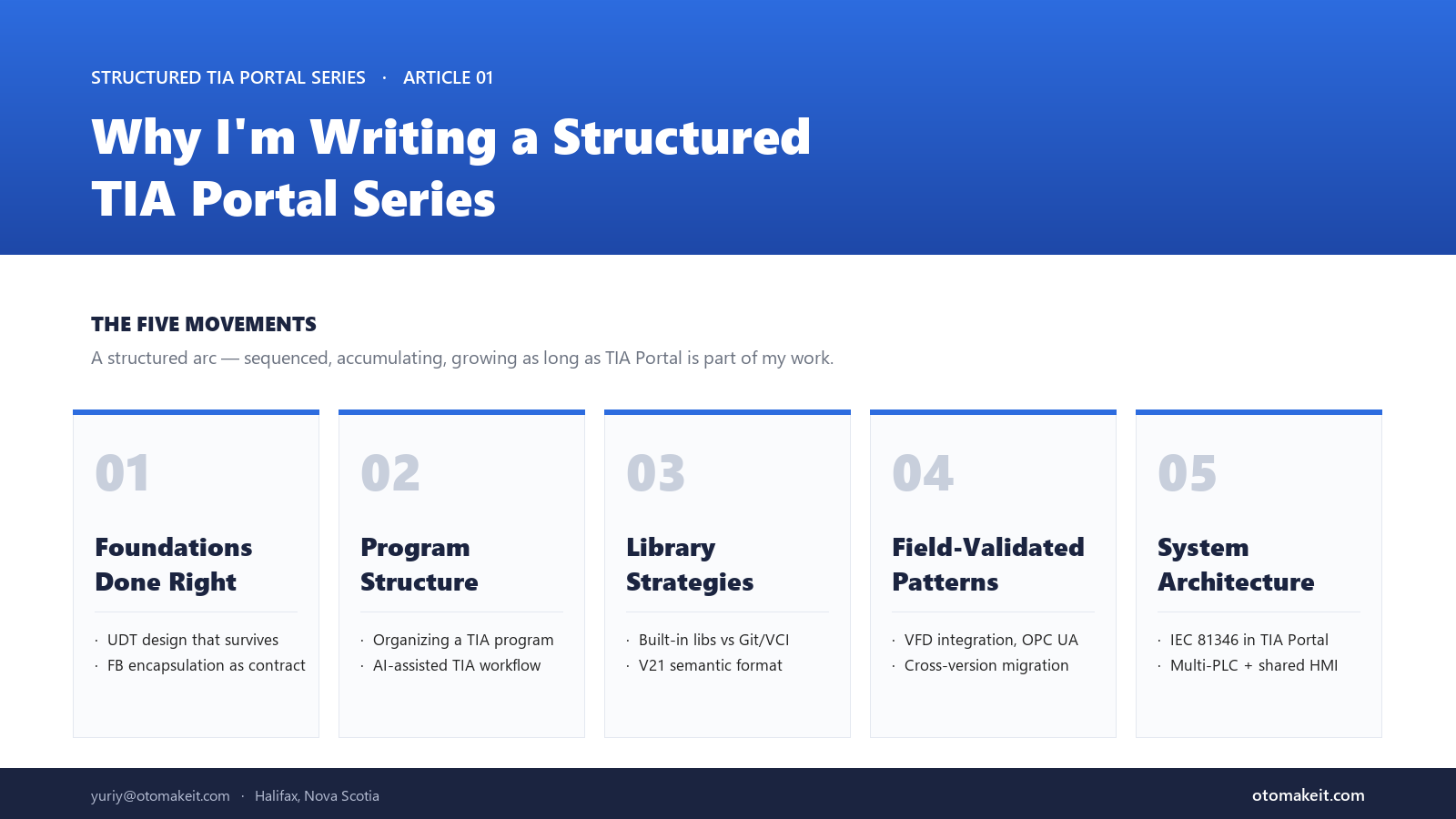
The series is organized into five movements. Here is a rough map of where it starts, with a few examples from each. The list is not exhaustive — it is the backbone, and other topics will land where they fit.
Meta — just this article. The only one that looks inward at the series itself.
Foundations Done Right — the topics that seem basic until you are maintaining them at scale. UDT design that survives real projects. Function block encapsulation — what it means to design an FB interface as a contract, one that an engineer you have never met can modify in year five without breaking everything. These come next.
Program Structure — how do you actually organize a TIA Portal program? There is more than one answer, and each one has tradeoffs nobody mentions up front. There is also an article in this movement on AI-assisted TIA workflow — my actual stack, what works, what does not, and the honest economics of when it saves time and when it costs time.
Library Strategies — this is where I expect the most disagreement. TIA Portal’s built-in library system versus source-code libraries via Git and the Version Control Interface. The V21 semantic format and what it changes for ladder code. I have shifted my own approach over the past year, and I want to write through the reasoning carefully, not just announce a conclusion.
Field-Validated Patterns — this is the movement I am most interested in writing. VFD integration from real marine and industrial projects. The OPC UA disconnect storm — why it happens, what patterns actually tame it. An article on the April 2026 discovery that Windows display scaling on the engineering workstation silently breaks WinCC font rendering during compile — one of those bugs that looks like a panel problem until you find the real root cause. Cross-version migration — what breaks, what does not.
System Architecture — IEC 81346 functional hierarchy applied to TIA Portal. Multi-PLC architectures with shared HMI. Safety integration patterns.
These are not topics I invented for the sake of having a syllabus. They are the things I have been working through on actual customer projects over the past several years. Some of the articles will reference specific commissioning experiences. Some will have demo projects. All of them will show the reasoning, not just the conclusion.
What to Expect from Me
A few things I want to be clear about before the series gets moving.
I am not an expert, and I am not going to position myself as one. I have years of TIA Portal work. I have been through enough difficult commissioning situations to have strong opinions about certain things. But I also know that there are engineers out there who have solved problems I have not encountered yet, and some of them have probably solved them better than I would have.
When I have a strong position, I will state it clearly. When something is a workaround rather than a proper solution, I will say so. When a Siemens roadmap item is a soft expectation rather than a confirmed delivery, I will frame it that way. When something is specific to S7-1500 and I have not tested it on S7-1200, I will say that too.
I will also correct mistakes openly. If an article in this series turns out to be wrong about something, the follow-up article will say so. That is not just a policy — it is the only approach that makes the series useful over time.
Cadence and Continuation
Roughly one article a week. No fixed end date. The series continues as long as TIA Portal is part of my customer work, which means it will keep going for a long time.
If you want to push me toward a specific topic — a TIA Portal problem you have been wrestling with that nobody seems to write about clearly — leave a comment or message me. I take topic requests seriously. Real-world problems make better articles than abstract plans.
Let’s Go
The next article covers UDT design patterns that survive real projects. Not the basics of what a UDT is — the decisions that determine whether your UDTs become an asset or a liability when the customer asks you to restructure the data model three years into the project.
If you have worked through that problem — if you have a UDT design approach that has held up under real-world change pressure — I want to hear about it. And if you disagree with where I land, I would rather hear a better answer than be right.
